How salt inhibits the growth of trees and hedges
When de-icing salt enters the soil, it alters the conditions in the root zone and disrupts the water and nutrient balance.
The main effects of salt stress are:
Reduced water uptake
Salt draws water away from the root zone, forcing plants to expend more energy to absorb moisture.
Disrupted nutrient uptake
Plants can no longer absorb essential nutrients or find it more difficult to do so, which slows down growth.
Root damage
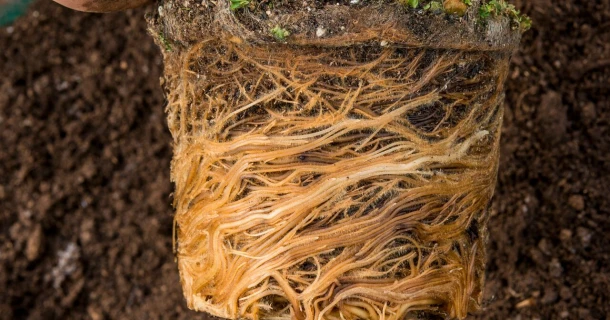
Fine roots are particularly sensitive to salt. They deteriorate more rapidly, restricting root development and weakening the plant’s ability to restart growth in spring.
Why rain does not solve the problem
It is often assumed that rain will naturally wash salt out of the soil. In practice, this is not always the case. Along paved surfaces, soil structure is often already disturbed. Rainwater infiltrates more slowly and compacted soil layers hinder the effective leaching of salts. As a result, saline water tends to remain trapped within the root zone.
Over time, salt stress can accumulate across successive winters. Even prolonged or heavy rainfall may only partially remove the built-up salts. Young plantings, which still have limited root systems, are particularly vulnerable to these conditions.
Typical signs of salt stress
Salt stress is not always immediately visible, but there are clear signals that garden contractors can observe.
One of the first indicators is localised growth delay. Plants along paved surfaces develop more slowly than the same species elsewhere in the garden or on the site.
In addition, other symptoms may occur:
Less strong shoot growth in spring
Limited root development
Discolouration or slow leaf development
Less uniform hedge growth
Because these symptoms tend to develop gradually, the underlying cause is not always directly linked to salt stress.
Nevertheless, it is worth staying alert to these signals. An accurate diagnosis makes it possible to tackle problems in a targeted way and helps avoid unnecessary replanting.
How to tackle salt in a targeted way
When salt builds up in the root zone, simply waiting for conditions to improve is usually not enough. The soil requires a specific approach to remove excess salts.
This can be achieved by facilitating the removal of salts from the root zone and by stimulating soil life again.. A healthy soil life plays an important role in restoring soil structure. Micro-organisms help rebalance the root environment, enabling stressed plants to regain their ability to absorb water and nutrients effectively.
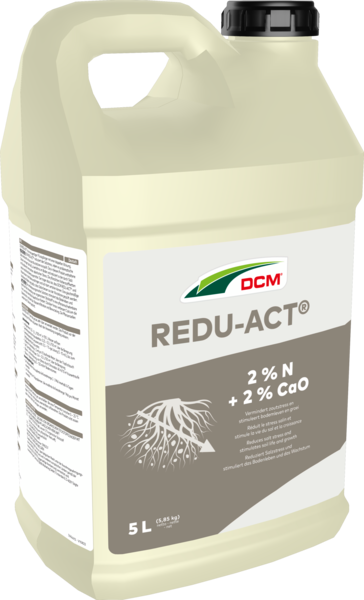
DCM REDU-ACT®: helps reduce salt stress in the root zone
DCM REDU-ACT® provides targeted support against salt stress along paved surfaces. It reduces salt stress by exchanging problematic salts and leaching them out of the root zone.
The calcium contained in this product lowers the Na/Ca ratio in the soil and thus reduces abiotic stress caused by salt in the root environment. Plant-based carbon chains act as a natural wetting agent. They help DCM REDU-ACT® and water penetrate and distribute more effectively in the soil. A uniform distribution in the soil ensures that salts are more efficiently flushed out of the root zone.
In addition, the organic matter present stimulates soil life and thereby promotes the conversion of organic nitrogen into a plant-available form, enhancing above-ground growth. Calcium also improves soil structure, as well as water infiltration and rooting. Plant cells are strengthened by calcium.
Discover the trial results of DCM REDU-ACT® in grass here.
As with fertilisation, timing is crucial. By applying the right treatment at the right time, soil balance can be restored before the growing season really begins.
Why drought can make salt stress even worse
What this means for you as a garden contractor
By recognising salt stress and tackling it in a targeted way, garden contractors can avoid frustration and additional work in spring. Existing plantings do not need to be replaced; a targeted soil approach may already be sufficient. Clearly communicating the impact of de-icing salt helps customers better understand why plants may show reduced growth, even when the planting was properly installed.
With the right knowledge and supportive products, the root zone can recover. This allows plantings along paved surfaces to continue growing, without any doubts about the quality of your work.