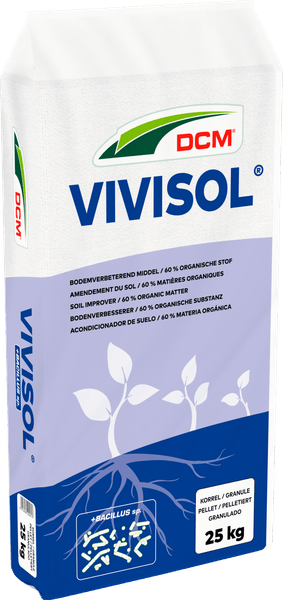
asparagus plants develop significantly more roots (up to 64% more!), enabling them to absorb more nutrients from the soil. As roots build up sugar reserves that the plant can utilise in subsequent production years, enhanced root development is particularly important during the first years of growth.
asparagus plants accumulate more sugars (up to 36% more), an important indicator of harvest potential in the years to come.
The benefits of DCM VIVISOL® MINIGRAN® at a glance:
Increased root development during the first year
Improved nutrient use efficiency through enhanced nutrient uptake
Vigorous asparagus plants
A healthy, active and diverse soil life
Base fertilisation
Fertilisation is essential in asparagus cultivation to obtain a strong crop capable of building up the sugar reserves required for the following season through photosynthesis.
DCM specialises in the production of organic and organo-mineral fertilisers as well as soil improvers. DCM also manufactures a range of fully organic products, some of which are SKAL / FiBL (organic) certified. Because these raw materials differ in nutrient value and release rate, we can combine them into an easily spreadable pellet or homogeneous MINIGRAN® microgranule that makes nutrients available to plants quickly, gradually and over an extended period. This allows asparagus plants to receive a continuous and balanced nutrient supply, resulting in uniform and healthy growth, the foundation of a successful organic crop.
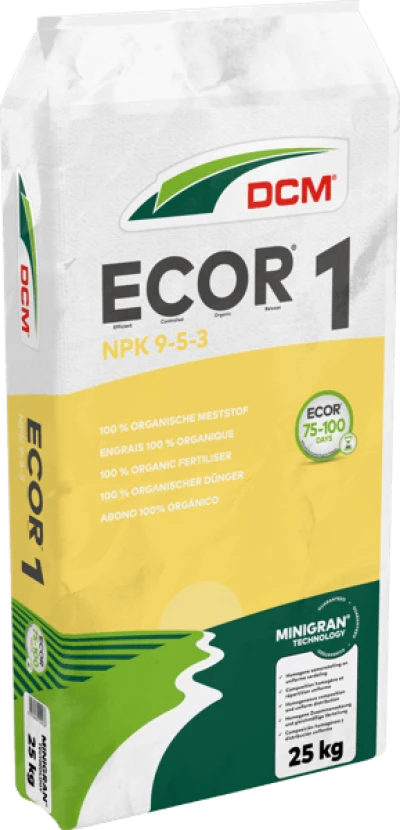
For organic production, a range of ECOR-fertilisers is available, each with a different composition (NPK). Based on soil analysis results, the most suitable product can be selected from our extensive range. As a result, nutrients are released steadily for at least three months. Thanks to their organic origin, ECOR-fertilisers do not contain ballast salts and nutrient leaching is greatly reduced, even under conditions of high rainfall. In addition, the organic raw materials provide a food source for soil microorganisms, supporting healthy soil life and healthy crop growth.
The MINIGRAN® formulation (very small granules with a homogenous composition) ensures an even distribution and a large contact surface with the soil, allowing nutrients to become optimally available to the plant.
Ask for more information about the possibilities and formulations available, adapted to your plants and soil type.
Trace elements
Trace elements are the vitamins of the plant. Although only small amounts are required, they are essential for certain physiological processes. They often form part of the (co)enzymes in the plant or play a role in energy production and conversion. When trace elements are lacking, plants will show deficiency symptoms. So despite their low required quantities, trace elements are just as essential for a plant as nitrogen or potassium.
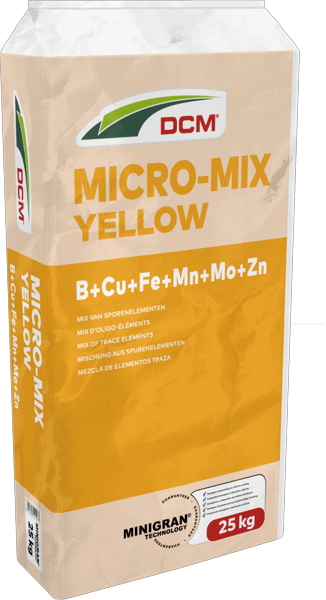
It is also important to pay sufficient attention to soil pH, since some trace elements become poorly available when pH levels are too high or too low. In many cases, deficiencies are corrected through foliar applications. However, these treatments are generally curative and provide only a temporary solution. DCM MICRO-MIX YELLOW has been developed as a spreadable soil-applied trace element fertiliser. It is recommended when soil analysis shows insufficient trace element levels. In addition, it provides a basic supply of trace elements throughout the growing season.
DCM MICRO-MIX YELLOW
Spreadable organic trace element mix (0.25% boron + 0.25% copper + 1% iron + 0.5% manganese + 0.02% molybdenum + 0.4% zinc)
Enriched with organic matter, creating a temporary buffer for nutrients
Nutrients are released gradually according to the plant’s needs
Available in MINIGRAN® TECHNOLOGY, a uniform microgranule ensuring even distribution, even at low application rates.
Every MINIGRAN® granule contains the same ratio of trace elements!
Calcium fertilisation or pH increase
Calcium plays an important role in the quality and storage potential of asparagus. Within the plant, calcium contributes to the formation of strong cell walls and helps produce firmer, higher-quality plants, thereby improving plant resilience. Plants absorb calcium as a divalent positively charged ion (Ca²⁺), which is taken up only by young roots. Calcium uptake is a passive process: it moves with the water flow into the roots and is subsequently transported through the xylem to actively transpiring parts of the plant. Once it has reached its destination in the plant, calcium is stored in the vacuoles or in the cell wall space. Calcium is therefore immobile within the plant. Young, rapidly growing leaves have a particularly high demand for calcium.
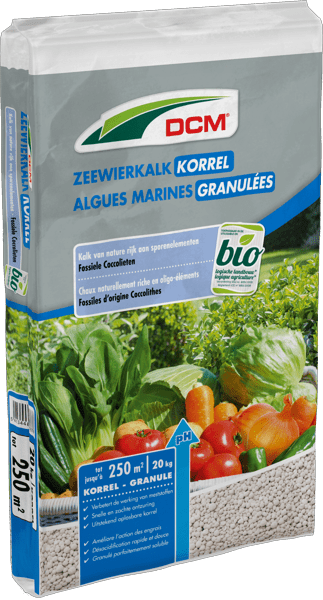
DCM SEAWEEDLIME GRANULES (pelleted seaweed lime) is a soft lime derived from young coccoliths that provides an easily available source of plant-available calcium. This spreadable granule contains 45% CaO of young origin, ensuring rapid calcium availability for the crop. DCM SEAWEEDLIME GRANULES is also SKAL / FiBL certified.
Besides supplying calcium, DCM SEAWEEDLIME GRANULES can also be used to increase soil pH. With a neutralising value (NV) of 50, it allows the pH to be raised more rapidly. Application recommendations should always be tailored to individual conditions and based on soil analysis results.