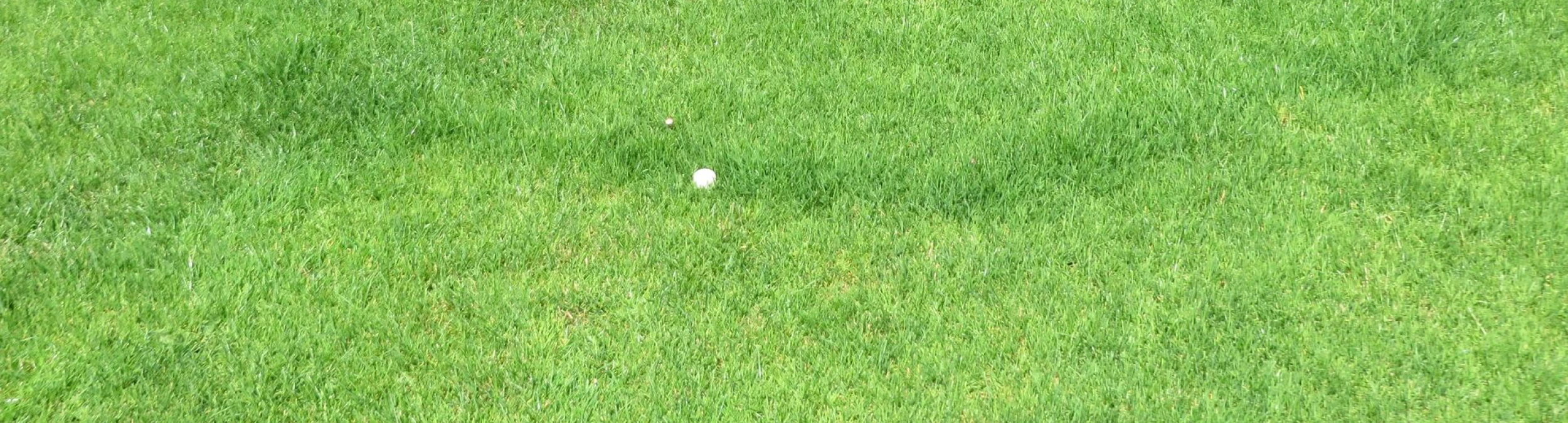
A dark green circle, an area of weakened turf or mushrooms forming an almost perfect ring: a fairy ring is often easy to recognise, but less easy to manage. On sports pitches, golf courses and other high-quality turf surfaces, differences in colour, growth and water availability also quickly become noticeable.
For landscapers, greenkeepers and sports turf managers, it therefore pays to look beyond the visible symptoms. After all, fairy rings are primarily a below-ground phenomenon.
What is a fairy ring?
A fairy ring develops from fungal mycelium: a network of fine fungal threads in the soil. The mycelium grows outwards from a starting point, creating a circle or arc.
In the Netherlands and Belgium, the fairy ring mushroom (Marasmius oreades) is one of the fungi associated with fairy rings in turf. A small ring can expand year after year into a ring several metres across and can remain in the same location for many years.
Not all fairy rings look the same
Symptoms vary depending on the fungus, season and conditions. Possible signs include:
mushrooms growing in a circle or arc;
a dark green ring or more vigorous grass growth;
weakened or dried-out turf;
localised turf dieback.
Mushrooms mainly appear under moist conditions. In spring, the grass around the ring may grow more vigorously and turn darker green, while during dry periods signs of drought stress may become visible.
So do not look at mushrooms alone. Recurring ring-shaped differences in growth or moisture can also indicate a fairy ring.
Why is the grass sometimes greener?
Many fungi that cause fairy rings live on dead organic matter such as roots, grass clippings, leaves and woody debris. As this material decomposes, nutrients can become available, causing the grass to grow more vigorously and develop a darker colour locally.
This does not necessarily mean that the turf is performing better in that area. Elsewhere within the same ring, drought stress may occur.
When water struggles to reach the root zone
The mycelium can form a dense network in the soil. In some fairy rings, the soil can also become locally water-repellent or hydrophobic. Irrigation water then infiltrates less easily and reaches the root zone less evenly, potentially resulting in drought stress and poorer root development.
Where hydrophobic conditions are involved, a wetting agent can be considered alongside appropriate soil and irrigation management. DCM INTRO® 2.0 can help water penetrate water-repellent soils more effectively. Such an application should always be considered as part of a broader approach to soil structure, thatch, rooting and irrigation.
Why do fairy rings develop?
There is usually no single clear cause. Thatch, organic matter, drainage and the nutritional status of the turf can all play a role. It is therefore important to assess the entire growing environment rather than identifying one factor as the cause.
5 key points for professional management
1. Limit thatch and organic matter build-up
Scarifying, aeration and other mechanical treatments can help limit excessive thatch build-up. Adapt your approach to the grass species, soil, season and use.
2. Check compaction and rooting
Intensive foot traffic and machinery can compact the soil. Regularly check soil structure and rooting depth. In the case of recurring problems, also compare the affected area with a healthy part of the turf.
3. Check water infiltration
More irrigation is not automatically better. Check how quickly and evenly water infiltrates and how deeply moisture penetrates the soil. In hydrophobic soils, a wetting agent can help improve water infiltration.
4. Tailor nutrition to the turf
Fertilisation does not remove the mycelium, but balanced nutrition does support uniform growth and the development of healthy turf. Tailor fertilisation to the needs of the grass, the soil and the intensity of use.
5. Look for sources of organic matter
Old tree roots, woody debris, dead roots and thatch can provide organic matter on which saprophytic fungi feed. In the case of persistent fairy rings, the history and construction of the site can therefore provide valuable information.
What should you avoid?
Applying extra nitrogen to mask differences in colour
This may temporarily make the difference less noticeable, but it does nothing to affect the mycelium below ground.
Automatically increasing irrigation
If water does not infiltrate sufficiently, applying more water will not address the underlying problem. Check the root zone first.
Only removing the mushrooms
Mushrooms are merely the above-ground fruiting bodies. The mycelium remains present in the soil.
Relying on a single management measure
Always consider thatch, soil structure, water availability, rooting and nutrition together.
Healthy turf starts below ground
Whether it is a garden, football pitch, fairway or tee, above-ground symptoms often reveal what is happening beneath the surface.
An integrated approach is therefore important when managing fairy rings. By assessing soil structure, water management and nutrition together, you can target the fundamental conditions needed to support healthy, vigorous turf.


