To put our mission into practice, our R&D department and the research centre Scientia Terrae vzw collaborate day after day to test our products and develop new innovations. Thanks to their in-depth analysis, we bring efficient solutions to the market. In doing so, we strive to keep the impact on the environment as low as possible, and that is exactly what we aim to achieve.
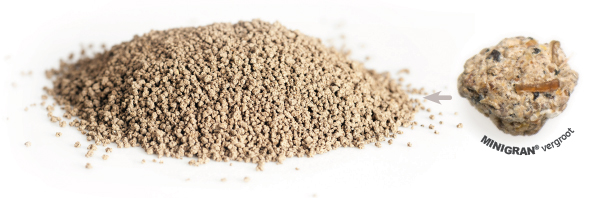
Our MINIGRAN® technology, used for the production of our organic and organo-mineral fertilisers, is a good example of product innovation. We developed mini granules that contain all the nutrients derived from organic raw materials (nitrogen, phosphorus, potassium, magnesium and trace elements).
These nutrients are gradually released by microbial activity as soon as the fertiliser granules reach the soil. Microbial activity is closely linked to plant growth, which means that the nutrients in our products are only released when the plant really needs them.
Our soil improvers and potting soils are continuously optimised with the right organic fertilisers, lime and other valuable components depending on the application or plant, for optimal soil fertility. Based on our own research and testing, DCM has also developed biostimulants, which, for example, ensure more efficient nutrient uptake and thus contribute to more vital plants and support of the root system.
Every year, we renew an entire product line, to continuously bring sustainable solutions to the market. Here are some of our recent innovations: a brand new line of liquid fertilisers containing 98% raw materials of natural origin, complemented with 2% micro-organisms and trace elements, suitable for organic gardening; a wide range of potting soils is now made from 100% raw materials of natural origin; grass seed mixtures composed of high-quality varieties that are, for example, more resistant to dry and warm summers; flower seed mixtures, which attract beneficial insects and thus contribute to biodiversity in our gardens.
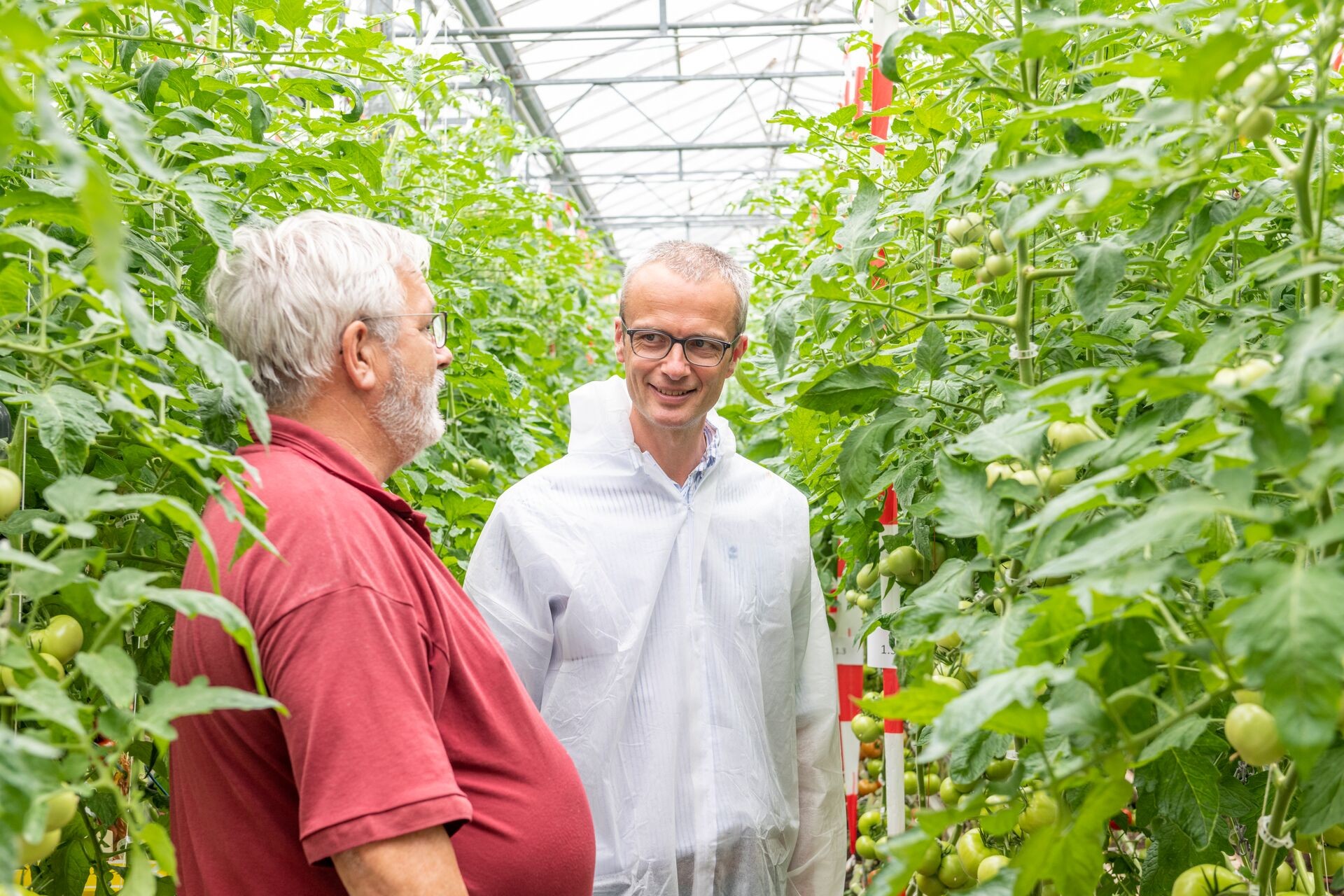
Did you know that through our plant clinic we collaborate with more than 20 research departments at universities and testing stations in Belgium, the Netherlands and abroad? Practical tests on grower’s premises and on sports fields in the 45 countries where we operate are also very important to continuously improve our products, as well as the internal and cross-border sharing of the knowledge that our DCM advisors acquire on this occasion.
According to DCM, efficient products are also a sustainable choice, because the better they perform, the lower the nutrient losses, which benefits the environment. In collaboration with nature, our fertilisers support strong plants, improve soil structure and – thanks to their diverse components – enhance soil life. Our expertise lies in the diversity of raw materials, ensuring balanced fertilisation. But what makes our plant nutrition particularly relevant for the environment?
Raw materials of organic origin: we produce our fertilisers using raw materials of natural origin.
Continuous and long-lasting effect: thanks to our intensive research and the specific composition of MINIGRAN®, our products release their nutrients in a controlled and gradual way over a period of 75 to 100 days. The precise combination of raw materials supports steady growth.
Supply matches plant demand because nutrients are released through microbial activity: before releasing the appropriate nutrients, the organic matrix of our fertiliser granules must first be decomposed by the microbial life in the soil. This way, we ensure that our fertilisers make their nutrients available to the plant roots at the right moment for plant uptake.
Reduced leaching: as the nutrients in our products are only released when the plant needs them, the risk of loss through leaching is limited and the impact on groundwater and surface water is reduced.
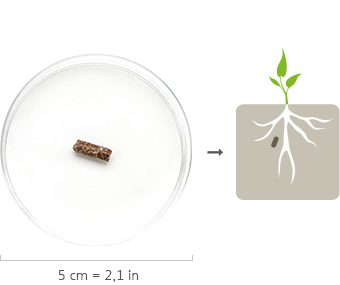
1 pellet
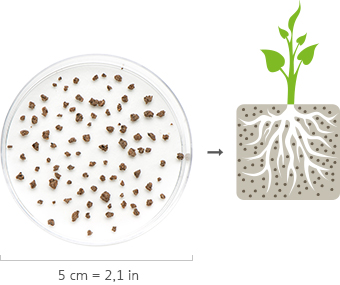
23 crumbles
94 MINIGRAN®
Did you know that our unique MINIGRAN® fertilisers ensure, thanks to the small size of their granules, an up to 60% better distribution in comparison with organic fertilisers of other manufacturers, which increases their efficiency. Applied on lawns, for example, this means that the granules dissolve faster and penetrate the soil instead of being picked up while mowing.
SDG 12.2:
Ensure sustainable management and efficient use of natural resources.
SDG 12.5:
Significantly reduce waste generation through prevention, reduction, recycling and reuse.