A calcium deficiency in arable crops can have a direct impact on the storability, disease resistance and yield of the final product. Soil analyses show that calcium availability is too low on many arable fields. To ensure that crops can absorb sufficient calcium, several solutions are possible.
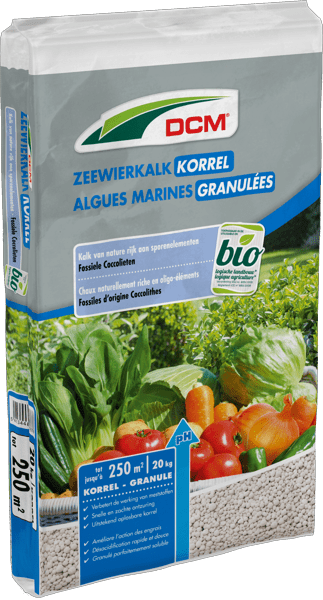
With DCM SEAWEEDLIME GRANULES, DCM offers the possibility to restore the soils calcium supply immediately before sowing or planting – or, in the case of potatoes, before ridging. These spreadable granules consist of very young coccolith lime, which reacts quickly in the soil thanks to its young geological age. The granules can be spread well up to 27 to 30 meters and offer an excellent price-quality ratio.
Calcium is a relatively large element that is mainly taken up by the youngest roots and, in the case of potatoes, also directly by the tuber. Calcium uptake occurs primarily at the beginning of cultivation, making it essential that calcium is available at that time. Because calcium in the soil is not very mobile and has difficulty moving, the best results are achieved when DCM SEAWEEDLIME GRANULES are applied as close as possible to the young roots.
A broadcast application of 300 to 600 kg per hectare meets the calcium requirements of various crops. This application has been used successfully for many years in crops such as potatoes, onions, celeriac, cabbage and other arable and vegetable crops.
Applying calcium in this self-spreadable, fast-acting and long-lasting form offers several advantages. Calcium strengthens the cell walls of both the crop and the final product, creating a stronger barrier against pathogens. DCM SEAWEEDLIME GRANULES ensure rapid availability of calcium and, thanks to the carbonate compound, provide a long-lasting effect throughout the entire growing season.
DCM SEAWEEDLIME GRANULES are available from your DCM distributor in 600 kg big bags or 20 kg bags.